

The winds of change: A renewable future for Northern Ireland
A report by Peter Stäuber
Drumlin Co-op produces sustainable energy from six wind turbines. It is also committed to helping support local communities and educational projects.
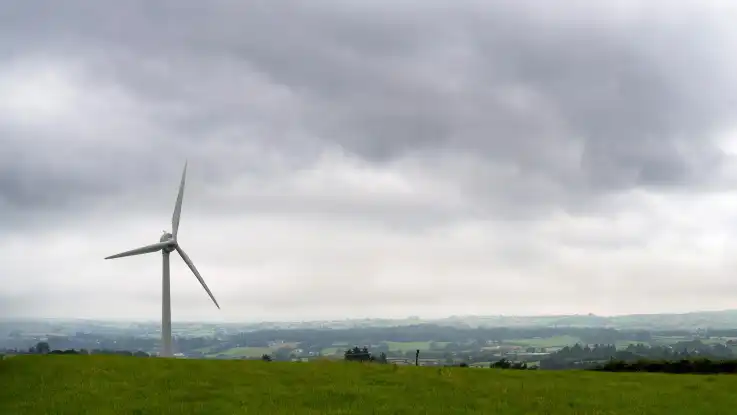
It is wet and quiet in the hills of Aghafad in County Tyrone, Northern Ireland. As we trudge through the swampy grass, all we can hear is the squelching of our boots and the babbling of a small brook that meanders between gnarled alder trees and gorse bushes. But when we stop and listen, there is another sound: the regular whooshing of a huge rotor spinning on a nearby hill.
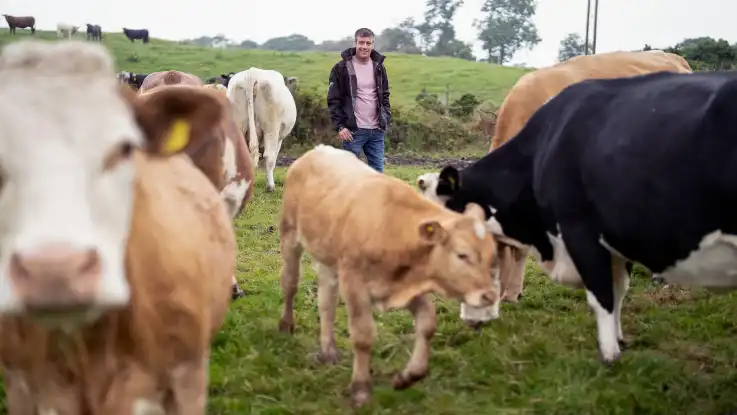
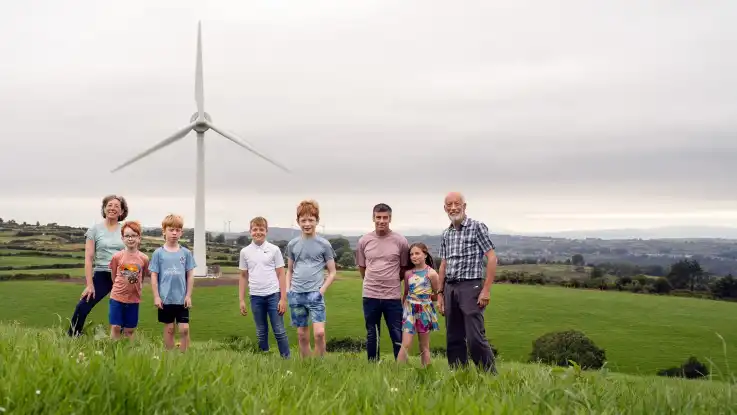
Cormac Clarke is standing in front of the turbine, arms folded, looking up at the imposing structure. The 47-year-old farmer is wearing a dark blue quilted jacket, cargo trousers and wellies. He grew up here and took over the farm from his father a few years ago. Clarke is a friendly, quiet, almost shy man, who does not possess the typical Northern Irish propensity for idle chatter. He breeds cattle – more than 200 are currently munching hay in the barn – has a chicken farm, and earlier in the day we spotted his sheep on a hillside. Clarke was up by 6 a.m. this morning to collect eggs from his hens. In the early afternoon, somebody will come round to buy three of his cows.
Aside from his job as a farmer, Clarke is also a member of a co-operative – and one of the first people in Northern Ireland to join a communal wind energy project. In a few words, he tells us how it all began: “One day, probably more than ten years ago, a man called Andrew McMurray came round. He was looking for a suitable place for a wind turbine.” The hill behind Clarke’s farm was ideal: windy and not too close to other buildings. McMurray explained that he did not work for a big business; instead, he wanted to build an energy co-operative. “I agreed immediately,” says Clarke.
Renewables are the future!
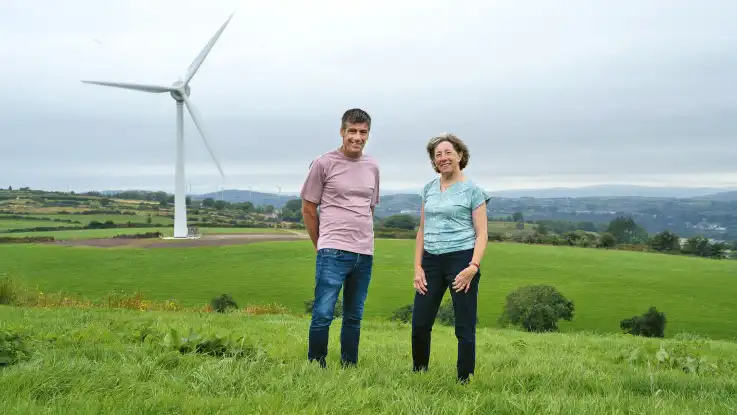
Not only did Clarke make his land available for the construction of the wind turbine, he also joined the co-operative. “Renewables are the future!” he says. He had already installed solar panels on his hen house, and wind power seemed to him the next logical step. The following year, the turbine – installed by Drumlin Wind Energy Co-operative – was already up and running on his hill.
It began with a government subsidy
As the first renewable energy co-operative in Northern Ireland, Drumlin is a pioneer. While England’s first communal energy co-operatives were established back in the 1990s, Northern Ireland was lagging behind. This changed around 15 years ago. In 2010, the government in Stormont launched the Strategic Energy Framework, which included an incentive for community energy projects. Its aim was to subsidise such projects by improving the profitability of small-scale wind turbines. To achieve this, the government introduced feed-in tariffs, which gave the owners of the wind farms planning security and a guaranteed income from the electricity that they feed into the grid.
Andrew McMurray – the man who turned up one day on Cormac Clarke’s farm – had an idea. At the time, the 44-year-old electrical engineer ran a consulting business for renewables. “I wanted to do something useful and saw a chance to build small-scale wind turbines,” he explains via Zoom. He did not want to generate profits for large investors, but to do something that would benefit the community. McMurray had long been involved in environmental campaigns, including with “Friends of the Earth”, a global network campaigning for environmental protection and social justice. He also had contacts at the non-profit “Energy4All”, which supports and advises more than 30 renewable energy co-operatives across the United Kingdom. “My friend at Energy4All and I decided to found the Drumlin Co-op,” says McMurray. The name is inspired by the local topography: “drumlins” are low, gentle hills that were shaped by glaciers during the ice age. Two of them are depicted in the co-op’s logo.
We wanted to encourage local people to invest in the turbines.
McMurray had already identified suitable locations for the wind turbines; Cormac Clarke was the first farmer he managed to win over. After he had secured the landholders’ agreement, McMurray and his friends at Energy4All started raising the money for the construction of the wind turbines. In 2012 they founded Drumlin and launched the share offer. The minimum investment was – and still is – 250 pounds, the maximum 20,000 pounds. It was a conscious decision to keep the minimum investment low so that people on modest incomes could still participate in the co-op. “We wanted to encourage local people to invest in the turbines,” says McMurray.
Soon Drumlin had raised 2.7 million pounds, and the Ulster Community Investment Trust provided an additional 340,000 pounds. Together, this was enough to build the first four wind turbines. Two years later the co-op launched a second share offer and raised another 1.2 million pounds, allowing them to build two more turbines. Today, Drumlin has six turbines dotted across Northern Ireland: in Aghafad, Ballyboley, Ballyrobert, Cavanakill, Cavanoneill, and Parkgate. Together, they have a capacity of around 1.5 megawatts.
More energy through repowering
In early 2025 Drumlin replaced two of its wind turbines, including the one on Clarke’s land, with newer, more efficient models – a process known as “repowering”. The 1.5 million pounds required for this project was raised mostly through a new share offer, supplemented by bonds from the members.
The installation of the new wind turbine was quite an event in rural Northern Ireland. Clarke shows a video on his phone of three huge lorries struggling to navigate the narrow, winding country roads, laden with 54-metre-long rotor blades. A concrete wall on his property had to be partially torn down to make way for the lorries, Clarke recalls. But it was worth it: the new wind turbine generates twice the amount of electricity as the old one.
Cormac Clarke does not have to do much – all maintenance and repair work is carried out by Energy4All. The electricity flows into a nearby substation and, from there, into the national grid. “We sell the electricity to power purchase and offtake companies, who then sell it on to other parties,” says Andrew McMurray. Although Northern Ireland is part of the United Kingdom, its electricity market has been linked to that of the Republic of Ireland since 2007 as part of the island’s Single Electricity Market. This means that Clarke’s electricity can also be sold a few kilometres further south, in the Republic. Like all landowners who lease their land to Drumlin, Clarke receives seven percent of the profit generated by his wind turbine.
Co-operation over profiteering
For McMurray and his co-founders, it was clear that Drumlin would be a co-operative. “Most energy producers in Northern Ireland are profit-oriented firms whose main goal is profit maximisation,” he says. “But being a co-operative allows us to benefit the local residents.” Their plan to involve local communities worked out: a good proportion of the more than 900 Drumlin members live in the vicinity of the six wind turbines.
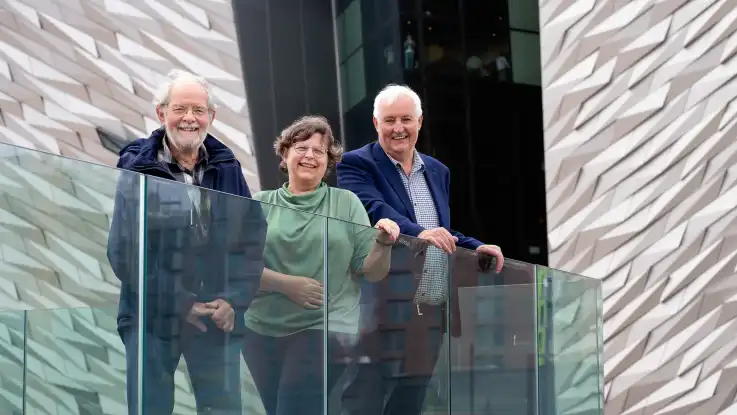
For Drumlin, working with and for local communities is essential. While members receive a small dividend every year, the biggest share of the profits is paid into a community fund for communal and educational projects. It was this aspect – the community work – that Anne Ford found so attractive and that motivated her to become involved in Drumlin. Ford grew up in County Antrim, north of Belfast, also on a farm. “The environment was always important to me,” says Ford. “Not only because I grew up on a farm, but also because of my line of work.” Together with her colleague John McMullan, who acts as Drumlin’s Chief Executive, she is sitting in a rather plain room in a North Belfast business park. The co-op does not have a fixed office, so they hire a room here for their board meetings.
We got to know a few energy co-operatives and saw what was happening – and our aspiration grew.
“I was a teacher in adult education, where my subjects were biology, chemistry and environmental science,” says Anne Ford. Around 13 years ago, she decided on a career change: at an agricultural show, she came across a leaflet with information about the plans to set up the co-operative. “My husband and I went to an event where we learnt more about Drumlin. Shortly after, the co-op organised a trip to southern Germany and I went along.” The group also visited EWS Schönau. The trip was very important for Drumlin: “We got to know a few energy co-operatives and saw what was happening – and our aspiration grew.” Ford was full of enthusiasm and applied for a job on the board; for more than ten years, she has acted as Drumlin’s chair.
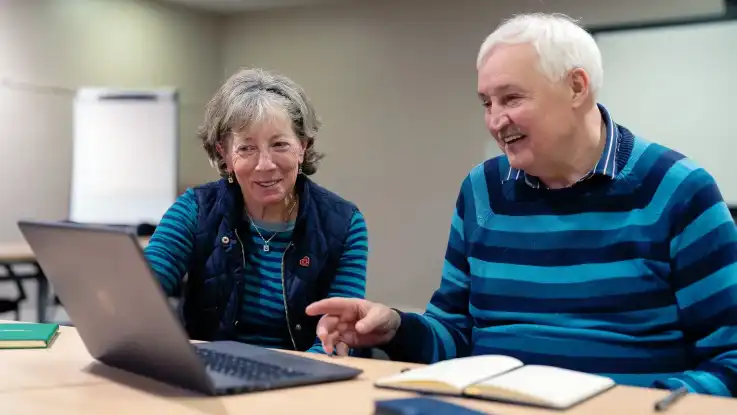
“The community fund is very important to us,” says Ford. While in the early years around 15,000 pounds was channelled into this fund annually, the sum has since risen to 30,000 pounds per year. Drumlin is hoping that the repowering of the two turbines will double that sum. “We use the money to finance social and environmental projects around the six wind turbines,” says Ford. For example, the co-op has installed solar panels on the roof of a community centre near Cormac Clarke’s farm. “This year, we’re planning to support individual residents who want to install solar panels on their homes.”
In keeping with the co-operative’s values, the largest part of the money in the community fund currently flows into educational projects. “We want to raise people’s awareness of energy: how it’s produced, how we can use it in a meaningful way, why we should use less of it – and how energy production impacts the environment and climate,” says Ford.
Joining the dots and sharing knowledge
Drumlin’s educational projects introduce younger generations to renewables and demonstrate how renewable energy contributes to fighting the climate crisis. To see how this is done, we visit Fairview Primary School in Ballyclare, some 15 kilometres north of Belfast. It is 9:30 a.m. on a grey morning. In the year six classroom, 27 excited ten to eleven-year-olds are sitting at their desks, dressed in smart dark blue school uniforms. Their school bags are hanging on the backs of their chairs, pencil cases placed neatly on the tables. On the blackboard, the teacher has scribbled a table with square numbers, and on the walls are pictures of Hitler and Spitfire planes – they are learning about World War II in history.
Why am I here today? To talk to you about renewable energy!
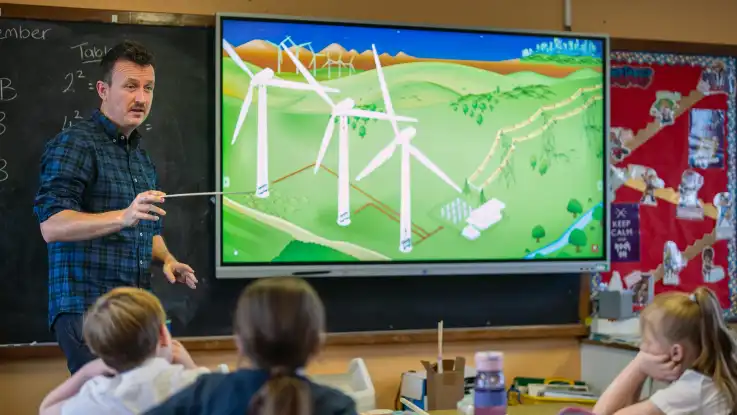
But the topic today is not war or maths – it is energy. Specifically: wind energy. Stephen Houston stands at the front of the class. “Today, you will become engineers,” he announces. The children’s faces light up. But before the practical part comes the theory. Houston, a lively 42-year-old who helps organise Drumlin’s educational projects, starts at the beginning. “When you turn on the light or the TV, where does the electricity come from?” he asks. “From these windmill things,” says a boy in the front row and points out of the window, where a few wind turbines can be seen. The nearest one is in Ballyrobert and belongs to Drumlin. “That would be nice!” replies Houston. “But unfortunately not. A large part comes from coal that we burn, and from gas. And what’s the problem with that? Why am I here today? To talk to you about renewable energy!”
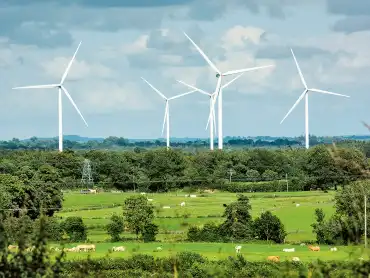
Wind energy is booming in Northern Ireland
Renewable energy has been making huge progress in Northern Ireland. Between 2005 and 2025, its share of the energy mix has risen from around five percent to nearly 50 percent – and wind energy accounts for more than 80 percent of that. By 2030, Northern Ireland wants to raise the share of renewables to 80 percent. But since Northern Ireland and the Republic of Ireland are island nations and therefore largely cut off from the European energy grid, energy bottlenecks and spikes could be a problem. To prepare for that, the Department for the Economy in Stormont has made the build-up of battery storage a priority.
Climate crisis and renewables
It soon becomes obvious that this is not the first time Houston has stood in front of a class of school kids. He used to be a primary school teacher and later became a headmaster. About four years ago, he was contacted by a friend who manages Drumlin’s educational programme BREESI (Bringing Renewable Energy to Schools Initiative). “He asked me if I would like to take over the school visits, and I said yes,” says Houston. The programme is extremely popular: each year, he visits 15 to 20 schools to talk to the kids about the dangers of the climate crisis and the significance of renewables – and to encourage them to get involved themselves. He often chooses schools that are located near Drumlin’s wind turbines. Today there is an even closer connection: Fairview Primary School is itself a Drumlin shareholder.
The children in Ballyclare have been directly impacted by the climate crisis on a number of recent occasions. In 2025, Northern Ireland experienced three heat waves – it was the hottest summer on record in Ireland. Extreme weather events are also becoming increasingly common: in that same year, the school had to close twice due to storms.
Little turbine engineers
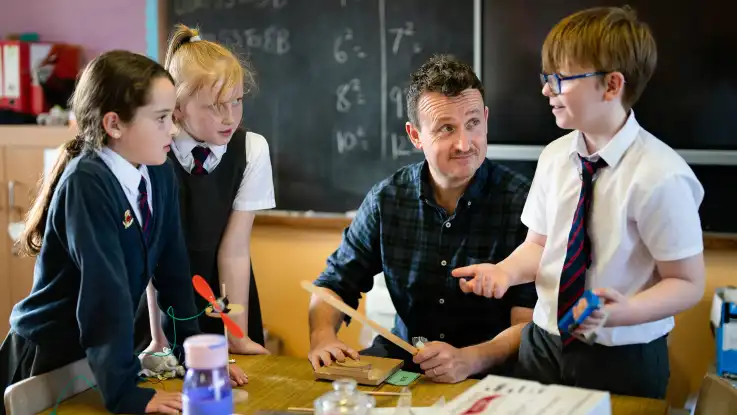
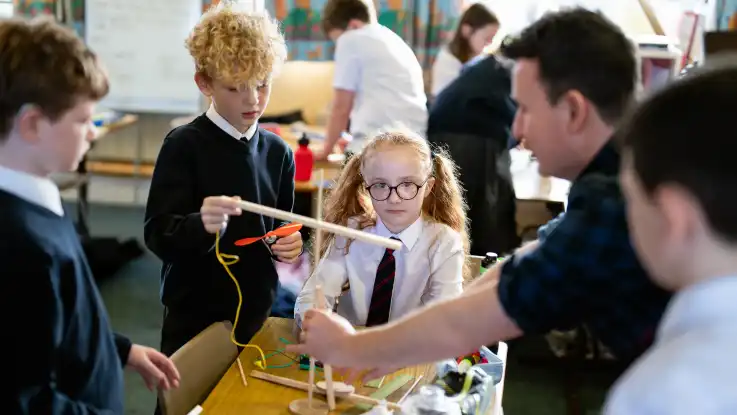
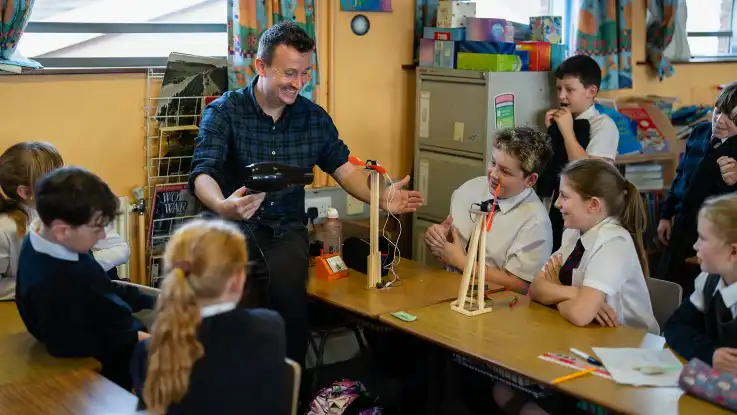
Tensions are rising in the classroom. The theory part is over, now it is time to build a small wind turbine model. Stephen Houston places a few boxes on the desk and takes out some wooden sticks, small plastic rotors, dynamos and cables. He demonstrates how the glue guns work and causes a collective, enthusiastic gasp when he takes out a saw. “Be careful with this!” warns Houston. “What the wind turbine looks like is completely up to you – but it has to work,” he explains.
The kids split into groups of three, take out pencils and paper, and draft a design for their model. Shortly after, they start sawing, glueing – and sometimes arguing. Penny frowns with concentration as she saws a wooden stick in two. Next to her, Caleb watches her every move. Afterwards, Leah glues four sticks together to build a solid base. Laurie, Lottie, and Corey, sitting at the neighbouring table, have decided to go for a more delicate design: they fix the dynamo on top of a small wooden disk, which they glue to a tripod made out of thin sticks.
Five minutes to go!
Stephen Houston goes from table to table, giving tips here and there. “Five minutes to go!” he shouts half an hour later. All of a sudden, things get hectic. One group has just dropped its initial design and is feverishly starting from scratch. There are strained faces all around and some of the white shirts now hang untucked from the kids’ trousers. It is the final push for the young turbine constructors.
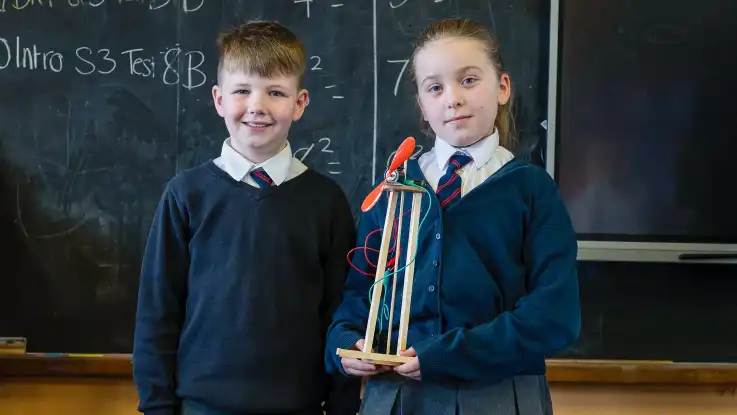
Time is up, and Stephen Houston asks the pupils to put away their tools. It is now time to test their machines. Houston has brought along a hair dryer, which he uses to try to get the miniature turbines to spin. He connects a small lamp to the dynamo: if it starts blinking, that means the dynamo is generating electricity. Each time it works, the whole class erupts in loud cheers. Some of the models are not very solid and are knocked over by the hair dryer – but all nine wind turbines are turning. Houston is full of praise: “Today you have learnt how renewable energy is generated,” he sums up proudly.
Houston is satisfied. A three-hour workshop is obviously not enough to give the kids a deeper understanding of renewable energy, he says: “But now they know more about the climate crisis and the role that renewables play.” Houston finds this age group perfect for an introduction into the topic: “When they get to 13 or older, they don’t tell their parents much about school. But ten to eleven-year-olds are still enthusiastic – and they already understand a lot of the technical and scientific context,” says Houston with a smile.
A new platform for initiatives
Back in Belfast, Anne Ford and her colleagues are looking to the future. The next repowering project is due to start soon: a third Drumlin turbine will be replaced with a more efficient model. “We’ve already got the planning permission,” says Ford. “We just have to decide how to raise the money.” Beyond that, the co-operative is expanding its focus to the whole energy sector in Northern Ireland.
The leadership team is in contact with other energy co-operatives as well as the Department for the Economy to form an umbrella organisation for co-operative energy projects. This is an initiative that Drumlin is helping to build. The planned organisation would form a platform for co-operatives to exchange experience, support new projects, and educate the public about renewables. It is an initiative that requires a lot of experience – but also a decent amount of self-confidence. “We see ourselves as an exemplar for what community energy can look like and what it can achieve,” says Ford. “A kind of waymarker.”
You can also read the report in German. / Lead photo: Toby Binder
-
«The energy transition can save democracy»
As the Brussels representative of European citizen-led energy initiatives, REScoop.eu aims to ensure EU citizens can play a central role in the energy transition.
-
The greek miracle of the sun
A cooperative on the island of Crete is combining community energy with active solidarity.